Long before children can explain their feelings in words, they understand the world through stories and movement. The characters they meet in fairy tales — the hero setting out alone, the shadow that threatens, the wise elder who appears at the right moment — are not simply fictional. For Carl Jung, they are expressions of universal patterns that live in every human psyche.
Research in neuroscience has found that storytelling and movement activate multiple brain systems simultaneously, supporting emotional regulation, memory, and a coherent sense of self (1, 2). When story and movement are brought together deliberately — as Anna Kelly and Natalie Southgate do through Chakradance Kids — children are offered something deeper than entertainment: a way to meet their own inner world through imagination and dance.
This article explores the psychology and neuroscience behind this approach, and what it offers children.
The child absorbed in a fairy tale is rehearsingrealityfrom the inside
Do you remember the first story that truly moved you? Perhaps it was a dragon-guarded tower, a wise old owl, or a magical forest. Long before children can explain their feelings in words, they understand the world through stories and movement.
Once upon a time, we all knew how to speak the language of symbols, rhythm, and magic. We believed in dragons, followed trails of breadcrumbs through the forest, and saw ourselves in wide-eyed heroes, clever foxes, and enchanted trees. These stories stayed. They shaped something. Understanding why — and what children are actually doing when they inhabit a story — turns out to be both psychologically rich and practically useful.
At Chakradance Kids, co-founders Anna Kelly and Natalie Southgate use fairy tales as mirrors of the inner self. Their work draws on over three decades of practice and on Carl Jung's insight that these ancient narratives are not childish fantasies — they are living blueprints of the human psyche.
Research finds that story and movement together activate the brain in ways that support emotional regulation, memory, and self-awareness
Research in neuroscience has found that storytelling and embodied movement activate multiple brain systems simultaneously — the language and reasoning systems alongside the emotional and imaginative systems — helping children integrate emotion with understanding (1). This integration is foundational for developing emotional regulation and a coherent sense of self.
The Neurosequential Model of Therapeutics, developed by child psychiatrist Dr. Bruce Perry, outlines how dysregulation in children is most effectively addressed through bottom-up regulation — through the body before the mind (2). Activities like dance, drumming, and rhythmic movement re-pattern the brain's deeper regulatory systems through rhythm, which is, in developmental terms, the first language the brain learns. Rhythm precedes words. Movement precedes narrative. When story is built on top of these foundations, it can reach places that words alone cannot.
When story meets movement, the whole child awakens — mind, heart, and body weaving together. This is, the research suggests, a description of what is neurologically happening.
Dr. Daniel Siegel, in 'The Whole-Brain Child', explains how storytelling helps children process and regulate their internal world by connecting emotional experience with logical understanding (1). Naming emotions and creating narrative structure are themselves regulatory acts — and when that narrative unfolds through the body as well as the mind, the integration deepens.
Jung's archetypes give children a symbolic language for the inner life theydon'tyet have words for
As the founder of Analytical Psychology, Carl Jung dedicated much of his life to exploring the hidden layers of the psyche. He believed the unconscious was a rich and creative space that held our future potential. Within it lived the archetypes — universal characters, themes, and patterns of behaviour that appear across cultures and generations. The Hero, the Wise Old Woman, the Trickster, the Shadow. These archetypes do not just live in our dreams or fiction. They live in us.
Jung once described fairy tales as the purest and simplest expression of unconscious psychic processes — symbolic narratives that allow us to safely explore the deeper parts of ourselves. Through these stories, we can face fear, betrayal, transformation, and triumph in a contained and meaningful way. When children connect with these stories through movement and imagination, the experience becomes both somatic and soulful.
In Chakradance Kids, we write our own fairy tales — each one crafted to correspond with one of the seven major chakras, or energy centres within the body, that relate to key areas of human experience. Each story contains magical characters, vivid landscapes, and archetypal challenges that mirror themes such as grounding, emotional expression, courage, compassion, truth, wisdom, and connection. Children are invited to close their eyes and enter the story through their imagination — sometimes flying on the back of a dragon, swimming with dolphins, or journeying through enchanted forests. They dance their way through the story, embodying the energies they encounter along the way.
We do not show pictures of the characters. Instead, we encourage each child to imagine the characters for themselves and to make a feeling connection with the story. They are living it inside their own bodies.
Archetypes appear in every culture's stories — and that universality is what makes them such powerful tools for children everywhere
Jung developed a process called active imagination — a method for accessing unconscious material by allowing images and feelings to rise while awake. Over 30 years ago, Natalie Southgate created Chakradance for adults as a powerful movement-based form of active imagination: a proven therapeutic process that helped individuals connect with their inner world through dance, music, and guided imagery, allowing unconscious material to safely surface and be integrated. Then, 15 years ago, we found a way to adapt this process for children, bringing it into classrooms, kindergartens, and family homes through the creation of Chakradance Kids.
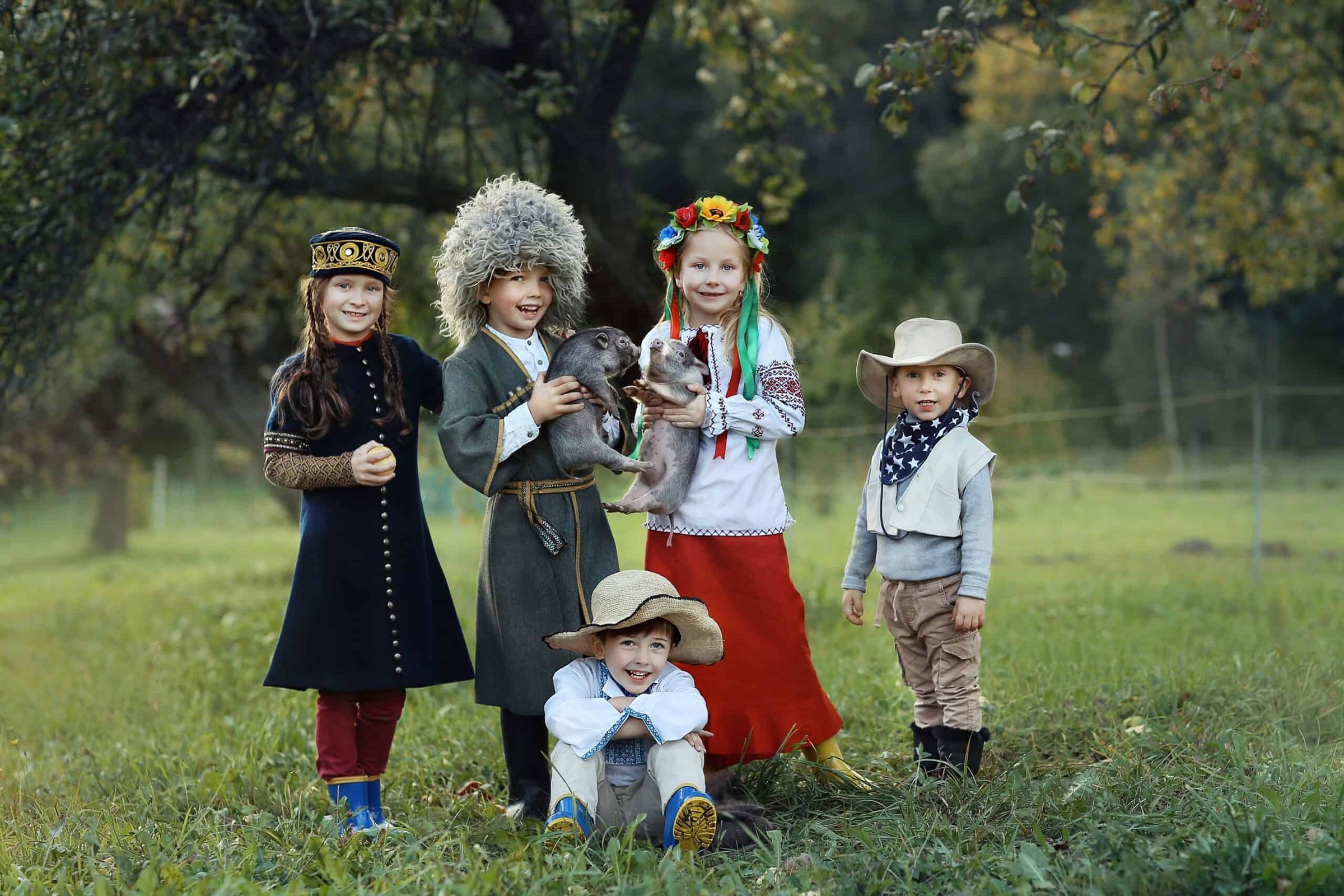
The characters and stories we use draw from the same deep well that Joseph Campbell documented across global traditions — the hero's journey, the departure, initiation, and return (3) — and that traditions worldwide have always known. Characters like the Hero, the Shadow, and the Wise Elder appear across West African trickster tales of Anansi the Spider, the Chinese Journey to the West, and Norse myths of Thor and Loki. These are, Jung believed, expressions of patterns shared across all human experience — which is why children everywhere recognise them.
Some evidence suggests that engaging deeply with stories can activate empathic processes in the brain and reduce social bias, allowing children to take on perspectives different from their own (5). When the stories come from many traditions — when the heroes look, speak, and live differently — children begin to see themselves in others, and others in themselves. This is the foundation of cross-cultural empathy, and it is built through story before it can be built through argument.
Not every child receives archetypes the same way — and what makes this work safe is its deep respect for individual difference
While the integration of fairy tales and movement in therapeutic settings offers significant benefits, it is essential to acknowledge potential challenges. Every child carries their own rhythm. Archetypes may speak in different tones to different hearts, depending on temperament, neurodiversity, and lived experience. Some children may feel discomfort or confusion when presented with intense symbolic themes, and this requires sensitive facilitation.
Cultural backgrounds also play an important role in how fairy tales and archetypes are interpreted. Symbols that are empowering in one tradition may be unfamiliar or even unsettling in another. True inclusivity begins with listening — honouring the cultural lens each child brings, and gently shaping the story so that all may find their reflection within it.
In Chakradance Kids, we never force an outcome. We simply create the conditions for the unconscious to reveal what it is ready to share. Jung believed the psyche was a self-regulating system — when given space and trust, it knows how to heal. Children are gently invited into their own process, whether that means dancing like a lion or quietly drawing after the story and dance.
TheChakradanceKids approach — story, movement, and mandala art — creates conditions for children to process their inner world without needing to name it
We discovered that children, too, can enter a gentle waking dream — using story and movement to access their own rich inner worlds. As they move, symbolic images emerge, emotions rise, and a new awareness begins to form. This process does not require analysis or interpretation. The healing unfolds through connection: between body and mind, emotion and imagination, unconscious and conscious.
After the dance, children express their experiences through mandala art — drawing inside a circle to represent what they felt, imagined, or discovered. These drawings become mirrors of their journey, holding the essence of what was lived, felt, and understood within. The mandala art anchors the experience and allows children to reflect on what arose, becoming a kind of treasure map — a key to the door of the inner journey they have taken and can return to again and again.
By engaging the whole brain and body together, these practices support children in strengthening memory and attention, developing empathy and emotional regulation, improving sequencing and cognitive function, and increasing creativity, confidence, and self-awareness. These benefits are woven into the experience — through every session, from story to movement to art.
What the Chakradance Kids approach offers children:
A symbolic language forthe innerlife. Before children have words for their feelings, they have images, movement, and metaphor. Fairy tales give them a vocabulary for inner experience — the shadow they are afraid of, the hero they might become — that is more accessible than direct emotional instruction (3).
Embodied imagination. By not showing images of the characters, Chakradance Kids ensures that each child generates their own version of the story — their own dragon, their own forest. This internal creation is active imagination in its most natural form, and it is the child's own process rather than someone else's.
A safe container for difficult feelings. The mandala art at the end of each session gives what arose in the movement somewhere to land. Children who have accessed something uncomfortable during the story have a way to externalise and reflect on it — to hold it in the circle rather than carry it unexpressed (1, 2).
Cross-cultural belonging through shared archetypes. Drawing on stories from multiple traditions creates an environment in which children from different backgrounds can see themselves reflected, and where the universality of human experience becomes visible to all (3, 5).
When children experience these stories in their bodies, theylive theirlessons
"The privilege of a lifetime is to become who you truly are." — Carl Jung
We believe this journey begins in childhood. Through fairy tales, children learn that life is full of mystery and challenge, but also wonder, resilience, and transformation. Through movement, they find their voice. Through art, they honour what they feel. And through the dance of archetypes, they meet their own inner magic.
When children experience these stories in their bodies, they live their lessons. And in doing so, they begin to understand themselves more deeply as whole, growing beings with their own rhythm, story, and light. That, for us, is the true magic of fairy tales.
About Chakradance Kids:
If you would love to learn more about our work or even explore the journey to becoming a Facilitator, you can learn more here.
[2] Perry BD, Szalavitz M. The boy who was raised as a dog: and other stories from a child psychiatrist's notebook. New York: Basic Books; 2017.
[3] Campbell J. The hero with a thousand faces. Princeton: Princeton University Press; 1949.
[4] Gallese V, Lakoff G. The brain's concepts: the role of the sensory-motor system in conceptual knowledge. Cogn Neuropsychol. 2005;22(3–4):455–479. https://doi.org/10.1080/02643290442000310
[5] Green MC, Brock TC. The role of transportation in the persuasiveness of public narratives. J Pers Soc Psychol. 2000;79(5):701–721. https://doi.org/10.1037/0022-3514.79.5.701
[6] Narvaez D. Moral complexity: the fatal attraction of truthiness and the importance of mature moral functioning. Perspect Psychol Sci. 2010;5(2):163–181. https://doi.org/10.1177/1745691610362351